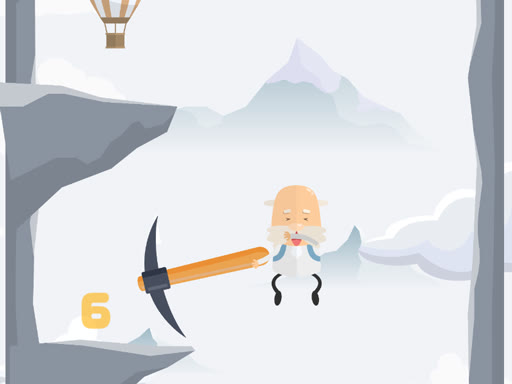
Getting Over It is a climbing game with no checkpoints and no mercy, and the browser version keeps the part that matters: the fall. It runs in the browser — no download, no account, no install.
Your character is a grandfather sitting in a pot. He has a hammer, and the hammer is the entire control scheme: press A and D, or the on-screen direction buttons, to swing it, and the mountain is climbed by hooking the head of the hammer onto whatever ledge or rock is within reach. It is a physics puzzle where the physics are the opponent.
The mountain is a vertical collection of junk — furniture, crates, anvils, a slide — and none of it is placed for your convenience. Every ascent is a series of small, deliberate movements where an over-committed swing that gains you a metre is also what sends you back twenty. Progress is not saved. A slip near the top costs you the whole climb.
That is the design, and it is honest about it: the game is about composure under a rule that will take everything back. What makes it bearable is that the movement itself is satisfying — the hammer has weight, and a well-timed hook that catches a ledge you were not sure about is genuinely rewarding.
It is a portrait game, sized for a phone, and the touch controls map directly onto the same two directions.
On cool games spot this page is the index entry: cover, description, and search terms. The game itself is a licensed GameDistribution build that loads in an iframe on Play, so nothing is bundled into the site. It is filed under action and tagged puzzle, so it appears alongside the rest of the puzzle games in the catalog.
Press Play and find out.






 Arcade
 Driving
 Action
 io
io Shooting
 Sports
 Adventure
 Simulation
 Word
Word Trivia